
Great Design Trawler Truths Design Discussions Economy Our Naval Architect
Twins v Single Shoal v Deep Stability v Ballast Fishtail Rudders Space Age Cores Core Materials Unsinkability
Twins v Single Shoal v Deep Stability v Ballast Fishtail Rudders Space Age Cores Core Materials Unsinkability
Fishtail Rudders
|
When Hull No. 34 of the Great Harbour series was launched, it was different than all its predecessors in an important way. This was the first Great Harbour Trawler fitted with a "fishtail" rudder instead of the flat-plate steel rudder of its predecessors. The fishtail rudder is foil shaped like an airplane wing with hydrodynamic endplates at the top and bottom. These rudders are built of dense, steel-reinforced fiberglass. Eager to assess the performance of the rudders, a group of Great Harbour owners decided to conduct a test
|
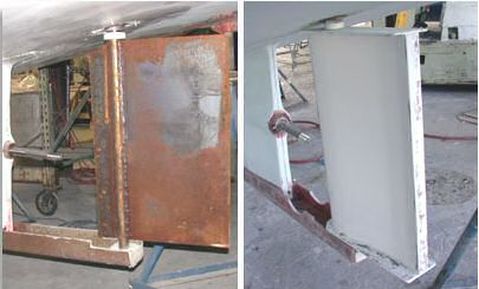
Th original steel rudder (left) and the composite fishtail rudder (right)
|
Lo Que Se A, A GH37 fitted with the new rudders, was put through a variety of turns at 500-rpm intervals, beginning at 1500 rpm's up to 3000. Berlie Mae, a GH37 with the old-style rudders, then undertook the same regimen. Chartplotters on both vessels recorded the circles made by each vessel at the various speeds and rudder angles. The diameters of each circle were then gauged by the plotter's cursor measurement function. The results were dramatic. Slow speed maneuverability is far better with the new rudders. So much so that the GH37 owners dubbed them "miracle rudders." Here's an example of the difference: At 2000 rpm's and 10-degree rudder, Lo Que Se A, fitted with the new rudders, turned in a circle with a .07-mile diameter. Berlie's Mae's diameter at the same revolutions and rudder angle was .18 miles.
Observing the tests was Brooke Williams, owner of the GH47 East Passage. Here's what he said: "Bottom line: at lower rpm's the new rudder cut circles at 1/2 the diameter of the old; at mid-range rpm's approximately 60 per cent and slightly less at the high end.
Observing the tests was Brooke Williams, owner of the GH47 East Passage. Here's what he said: "Bottom line: at lower rpm's the new rudder cut circles at 1/2 the diameter of the old; at mid-range rpm's approximately 60 per cent and slightly less at the high end.
Great Harbour's naval architect, Lou Codega, explains why our "fishtail" rudders work so well.
Rudders with flat plate or conventional airfoil shapes in cross section tend to stall when deflected to high angles, particularly so at low speeds. Once stall occurs, water is no longer flowing smoothly over the low-pressure side of the rudder; that is, the side toward which the stern is swinging. Instead, the rudder face is more or less covered with eddies and vortices. Lift drops dramatically and the turning moment remains essentially constant from that rudder angle onward. It's pretty obvious that this is exactly what the captain wants not to have happen, and, in my experience at least, the richness of the captain's vocabulary does very little to improve the hydrodynamics.
The new rudder design for the Great Harbour Trawlers is really an old one, and is derived from historical designs that sought to both extend the stall free range of rudder angle and develop high lift at all rudder angles. The end plates top and bottom increase the rudder's effective aspect ratio. In layman's terms, they force the water into behaving as though the rudder is far deeper than it actually is by preventing water from flowing over the ends of the rudder. This would rob lift producing pressure differential and create turbulence to increase drag. The fish shaped cross section, though, is really the key to success.
The rounded leading edge delays the stall angle, as does the wedge-shaped trailing edge on the low-pressure side. The wedge on the high-pressure face greatly increases lift from the back end of the airfoil, which is typically quite ineffective. And it shifts the center of pressure of the rudder aft a bit, allowing the rudder stock to be located closer to the center of the rudder, which in turn forces more of the rudder blade into the propeller's slip stream.
The first trial results have been outstanding. On side-by-side tests of identical boats fitted with the old and new rudders, the new rudders turned in one half the turning diameter of the old at low RPMs and about 60 percent of the diameter at high speed. The turning diameter at full RPM is now about three boat lengths. Disadvantages? For these boats, I don't think there are any. I was a bit concerned about astern performance, but there does not seem to be any difference.
Rudders like this are not more widely used on planing-speed boats and larger commercial vessels because they are terrifically difficult to build in ship sizes, will significantly increase drag at high speeds, and must be perfectly aligned with the prop wash. Fortunately, none of these factors come into play with Great Harbours, and the rudders fit perfectly into our philosophy of efficient, shallow draft, low-power cruising.
The new rudder design for the Great Harbour Trawlers is really an old one, and is derived from historical designs that sought to both extend the stall free range of rudder angle and develop high lift at all rudder angles. The end plates top and bottom increase the rudder's effective aspect ratio. In layman's terms, they force the water into behaving as though the rudder is far deeper than it actually is by preventing water from flowing over the ends of the rudder. This would rob lift producing pressure differential and create turbulence to increase drag. The fish shaped cross section, though, is really the key to success.
The rounded leading edge delays the stall angle, as does the wedge-shaped trailing edge on the low-pressure side. The wedge on the high-pressure face greatly increases lift from the back end of the airfoil, which is typically quite ineffective. And it shifts the center of pressure of the rudder aft a bit, allowing the rudder stock to be located closer to the center of the rudder, which in turn forces more of the rudder blade into the propeller's slip stream.
The first trial results have been outstanding. On side-by-side tests of identical boats fitted with the old and new rudders, the new rudders turned in one half the turning diameter of the old at low RPMs and about 60 percent of the diameter at high speed. The turning diameter at full RPM is now about three boat lengths. Disadvantages? For these boats, I don't think there are any. I was a bit concerned about astern performance, but there does not seem to be any difference.
Rudders like this are not more widely used on planing-speed boats and larger commercial vessels because they are terrifically difficult to build in ship sizes, will significantly increase drag at high speeds, and must be perfectly aligned with the prop wash. Fortunately, none of these factors come into play with Great Harbours, and the rudders fit perfectly into our philosophy of efficient, shallow draft, low-power cruising.